Sustainable Home Textiles
Tracing Recycled Cotton in Coyuchi Throws: Fiber, Origin, and Care
A recycled-content label offers a useful first clue, not a complete sustainability verdict. Coyuchi’s Full Circle throw makes a practical case study in how to read fiber percentages, manufacturing origin, and care instructions with both interest and healthy skepticism.
Published November 9, 2026
There is something reassuring about a blanket that feels immediately useful: close at hand on a cool evening, folded at the end of a bed, or tossed over the back of a favorite chair. Yet the story of a home textile does not begin when it reaches the sofa. It begins with the fibers, the decisions that bring them together, and the work required to turn them into something made for years of ordinary use.
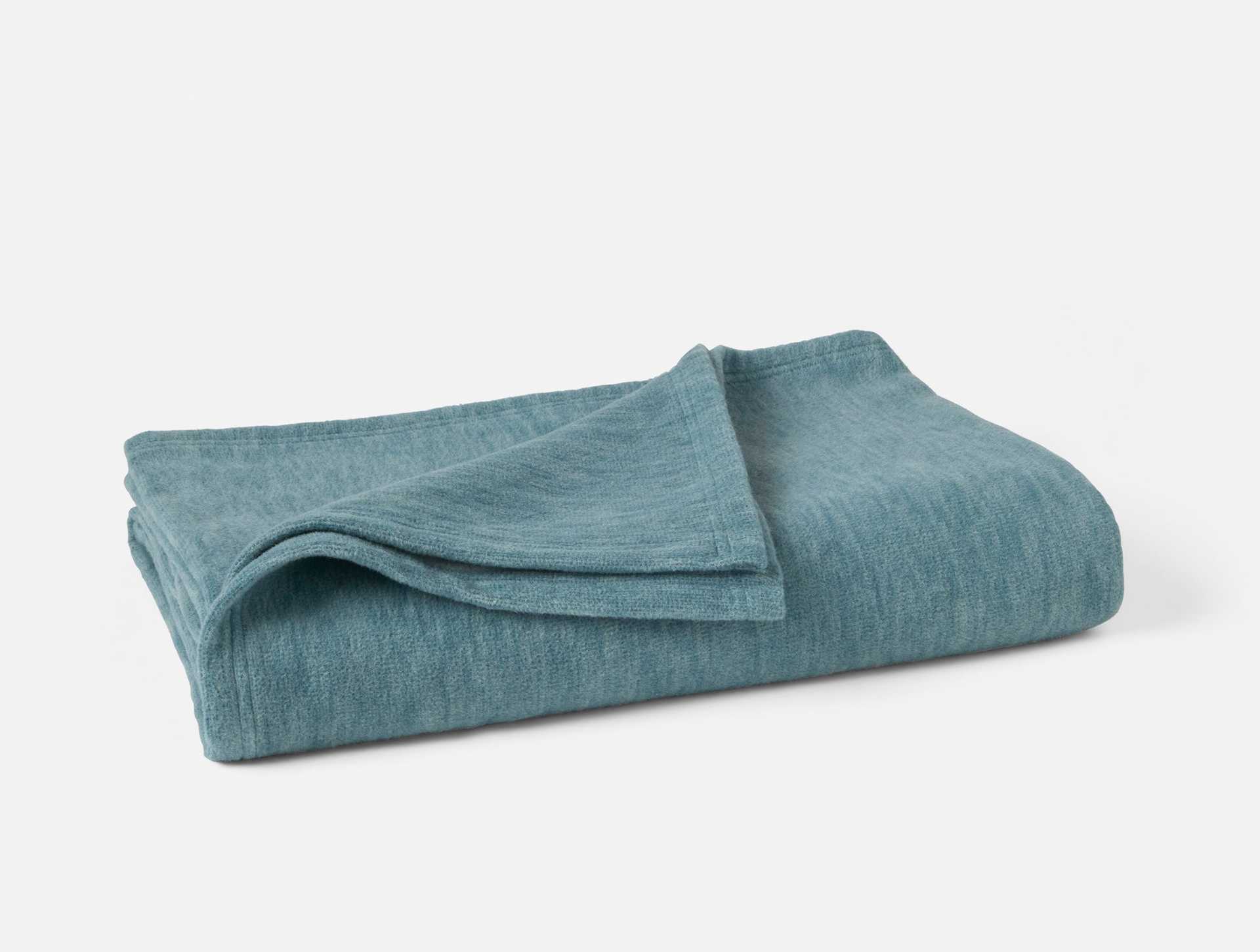
Coyuchi’s Full Circle Recycled Cotton Throw offers a clear example of how those details can be read. Its stated composition is 52% recycled cotton and 48% organically grown cotton, and its listed manufacturing origin is Germany. The throw is described as machine washable, with instructions to wash it cold on a gentle cycle with like colors and tumble dry on low. These facts are specific and useful. They help explain what the textile is made from and how to care for it, while also showing what a product description does not tell us on its own.
That distinction matters. A recycled-fiber percentage can describe a material input, but it cannot by itself account for every part of a product’s environmental or social impact. Country of manufacture is a valuable piece of supply-chain information, but it is not a full map of where each fiber was grown, collected, processed, or spun. Care advice can help a textile stay in use, but its real life depends on how it is treated and whether it is repaired, reused, or eventually recycled.
Rather than treating one label as a final answer, readers can use a product such as the Full Circle throw to practice a more grounded kind of textile literacy: notice what is disclosed, understand what the terms mean, and identify the questions that remain.
What the fiber percentages tell us
The first thing to notice is the balance of the blend. The throw is identified as 52% recycled cotton and 48% organic cotton. In plain terms, more than half of the stated fiber content is reclaimed cotton, while just under half is cotton described as organically grown. The figures make the material story more concrete than a broad phrase such as “eco-friendly” or “made with sustainable fibers.”
Percentages are most helpful when readers know what they refer to. A fiber-content percentage usually describes the composition of the textile, but product descriptions may not specify whether a figure is calculated by weight, whether it covers the whole finished item, or whether it applies to a particular component. For this throw, the listed blend is straightforward, but anyone comparing products should check whether the disclosure explains its scope and whether any trims or other components are excluded.
The term recycled cotton generally refers to cotton fiber recovered from textile waste or other previously used material, then prepared for use in a new product. Depending on the production route, recovered material may come from manufacturing scraps, discarded textiles, or a combination of sources. The phrase alone does not identify which source applies in a particular case. Nor does it establish whether the reclaimed fiber was mechanically or otherwise processed, or how much detail the supplier has documented. Those are reasonable follow-up questions where more traceability is important.
Recycled fibers can be part of a circular approach because they give existing material another use instead of relying entirely on newly produced fiber. But “recycled” is not a magic word that guarantees a product has no environmental costs. Collection, sorting, processing, transport, dyeing, and manufacturing still require resources. The relevant comparison depends on the source material, the recycling method, the quality of the resulting yarn, and the broader production system.
The second component, organic cotton, describes how the cotton was grown under a defined standard or program. It is not the same thing as recycled cotton. Organic status concerns agricultural practices and verification, while recycled status concerns the prior use or recovery of the fiber. A cotton product can contain one, the other, both, or neither. In this case, the listed blend combines reclaimed cotton with organically grown cotton, but the two percentages represent distinct material attributes rather than interchangeable claims.
Readers should also distinguish a fiber description from a certification claim. The product information states that the throw contains 48% organic cotton, but a shopper assessing the basis for that claim may want to look for an explicit certification, the relevant standard, and details about which parts of the product it covers. A certification can add verification, but its meaning depends on the scope and requirements of the specific standard. It is better to check the actual claim than to assume that every use of the word “organic” carries identical verification.
Recycling and circular textile design
“Circularity” is often used to describe efforts to keep materials in use for longer and reduce the need to treat products as disposable. In textiles, that can include designing for durability, recovering usable fibers, making products easier to repair, and creating routes for reuse or recycling after an item is no longer needed by its first owner.
A recycled-cotton blend fits into that conversation because it incorporates material that has already had a previous life or would otherwise have been treated as waste. Coyuchi describes the Full Circle throw as part of a circular approach to textile use. The disclosed blend makes one element of that approach visible: the throw includes a majority share of recycled cotton. It does not, by itself, establish that the finished blanket can be recycled again after use, or that every part of its supply chain operates as a closed loop.
That is not a reason to dismiss the claim. It is a reason to read it precisely. Circular design is a broad ambition, while recycled content is one measurable attribute. A product can make progress on one dimension without resolving every issue in textile production. Clear language helps readers see the difference between a specific input claim and a larger system-level goal.
Blended fibers raise practical questions about the next stage of a product’s life. Cotton combined with another fiber can be harder to separate than a single-fiber textile, although the exact challenge depends on the blend and available recycling infrastructure. Here, both listed components are cotton, which avoids the particular complication of separating different fiber types in the stated blend. Still, the product description does not tell us whether a take-back or recycling route is available for the finished throw. Local textile-recovery options vary, and an item’s eventual destination can depend on its condition and the programs accessible to its owner.
Durability is another part of the circularity story. A textile kept in regular use for a long time can provide value across many seasons, while an item that quickly loses its usefulness may be replaced sooner. The throw is presented as soft and suited to everyday living, with machine-washable care. Those are relevant practical details, but long-term performance can only be judged through use and suitable maintenance. The most responsible way to treat durability claims is as an intention or design feature, not a guarantee that every product will last for a fixed number of years.
What “made in Germany” means—and what it leaves open
The Full Circle throw is described as made in Germany. A manufacturing origin is a helpful detail because it identifies where the finished item was produced, rather than leaving its location entirely unstated. It may help a reader compare products, understand part of a manufacturing journey, or decide what additional information to seek.
But “made in Germany” should not be mistaken for a complete origin story. It does not automatically tell readers where the recycled cotton was collected, where the organically grown cotton was cultivated, where the fibers were spun into yarn, where the yarn was dyed, or where the fabric was finished. Textile supply chains commonly cross borders, and the last stage of manufacturing is only one point in a longer sequence.
For a more complete traceability picture, shoppers and researchers can look for information about fiber origin, yarn production, dyeing and finishing, the factory or manufacturing partner, and any standards or audits that apply. Not every product page will disclose each detail, and the absence of a particular detail is not proof of misconduct. It does, however, mark a limit on what a reader can confidently conclude from the information available.
Origin disclosures are most useful when they are specific and consistent. “Made in Germany” provides more information than a vague phrase such as “European craftsmanship,” but it answers a narrower question than a full supply-chain map. Keeping that distinction in view lets readers acknowledge the value of a disclosure without asking it to carry more meaning than it can.
Care instructions are part of the material story
For any household textile, care is not a small detail tucked away at the end of a label. The way a throw is washed, dried, stored, and used can affect its appearance and lifespan. In that sense, care instructions connect the product’s design to its everyday life in a home.
The Full Circle throw’s listed directions are specific: machine wash cold with like colors on a gentle cycle, then tumble dry on low. Following the guidance is a sensible first step. Cold water and a gentle cycle are less aggressive than a hot, high-intensity wash, while low-heat drying can help avoid unnecessary exposure to high temperatures. Washing with similar colors also helps reduce the risk of color transfer between items.
Care advice should not be turned into an unsupported promise about environmental savings. A cold, gentle wash may be a lower-intensity choice than a hot or extended cycle, but the total impact of laundering depends on many factors: how often the throw is washed, the washing machine’s efficiency, the load size, the energy source, and the drying method. If the blanket is not visibly soiled, airing it out or spot-cleaning a small area may sometimes be enough, provided those methods suit the item and its care guidance. Routine care should balance cleanliness with avoiding needless wear.
Before the first wash, it is worth checking the sewn-in label as well as the product information. Use a mild detergent appropriate for cotton textiles, avoid overloading the machine, and remove the throw promptly when the cycle ends. If the care label differs from an online description, the instructions attached to the item should take priority. Color, finishing, and construction can influence how a textile responds to washing, even when two products share similar fiber content.
Storage matters, too. A clean, completely dry throw stored in a dry place is less likely to develop unwanted odors or moisture problems. Folding it loosely rather than compressing it under heavy items can help maintain its texture. If a loose thread or small snag appears, addressing it early may prevent a minor issue from becoming more noticeable. These simple habits support the practical goal behind a recycled-content purchase: keeping a useful textile in use.
A useful case study, not a complete scorecard
The appeal of the Full Circle throw is that its basic material story is legible. A buyer can identify the stated blend, see that the finished product is made in Germany, and follow clear machine-wash care directions. Those details create a foundation for comparison and make the product more informative than an item described only in atmospheric language.
At the same time, no single feature should be mistaken for a full sustainability assessment. A recycled-content percentage says something about fiber inputs; it does not report the product’s total carbon footprint, water use, chemical management, labor conditions, packaging, or end-of-life pathway. Organic cotton is a distinct agricultural claim, not a complete account of manufacturing impacts. Manufacturing origin gives one location, not every location. Washability supports practical maintenance, but it does not measure how long the throw will remain in service.
A balanced evaluation asks how the product performs across several questions rather than looking for one perfect label. What is it made from? How much of each material is present? Are the claims clearly defined and, where relevant, independently verified? Where was the product made? What is known about the rest of its supply chain? Can it be cared for in a way that suits the household? Is it likely to be used often and maintained rather than replaced quickly?
Those questions are especially useful because sustainability is not a simple contest in which one fiber always wins. Recycled cotton, organic cotton, conventional cotton, wool, and synthetic fibers each have different production characteristics and trade-offs. The right comparison depends on the product’s function, its construction, the quality of the evidence, and how it will be used. For a throw intended as a regular household layer, comfort, care, and staying power belong in the conversation alongside fiber origin.
A reader’s checklist for recycled-cotton textiles
When evaluating a recycled-cotton throw or blanket, the following checklist can make product descriptions easier to compare:
- Check the exact blend. Record the percentage of recycled fiber and the percentage of any new fiber, rather than relying on a broad “recycled” headline.
- Look for a definition of recycled content. If the source matters to you, see whether the company identifies pre-consumer or post-consumer material, or explains another recovery route.
- Separate fiber claims. Recycled content and organic cultivation describe different attributes. Look for the wording and verification that apply to each one.
- Read the origin disclosure carefully. A country of manufacture is useful, but it may not identify where the fibers were grown, collected, spun, dyed, or finished.
- Review care before buying. A textile that fits your household’s laundry routine may be easier to maintain consistently. Follow the item’s own label.
- Consider the whole product. Ask about durability, repair, reuse, and end-of-life options in addition to its fiber content.
- Notice what is not stated. Missing information does not prove a claim is false, but it should limit how much can be concluded.
- Compare like with like. Similar products, intended uses, fiber disclosures, and care requirements make for more meaningful comparisons.
How the Full Circle throw fits into a home
A throw is a relatively simple textile, but its usefulness is part of its appeal. It can serve as an extra layer on a bed, a comfortable wrap while reading, or a practical cover for a sofa. The Full Circle throw’s cotton blend and machine-washable care are presented as everyday features rather than special-occasion instructions. That practical framing matters: a textile is more likely to stay part of a household routine when its maintenance feels manageable.
For readers exploring the product details, Coyuchi’s Full Circle Recycled Cotton Throw is listed with a 52% recycled cotton and 48% organic cotton blend, German manufacture, and cold, gentle machine-wash care. These specifications offer a compact starting point for understanding the item. They do not replace questions about broader sourcing or product life, but they give readers concrete facts to work from.
That is the most useful lesson in tracing recycled cotton: start with what is actually disclosed. Percentages can clarify the material mix. Origin can locate one stage of production. Care directions can help owners maintain a textile. Each detail answers a different question, and none should be treated as a complete sustainability report. Taken together, though, they help turn a throw from an appealing object into a product readers can evaluate with care.
The takeaway
Coyuchi’s Full Circle throw presents a specific material combination: more than half recycled cotton, paired with organically grown cotton, and made in Germany. Its machine-wash instructions add a practical note about keeping the textile in circulation at home. Those disclosures make it a useful example of circular textile design as an idea expressed through product details.
The clearest assessment remains a measured one. Recycled fiber can help put existing material to another use, but the percentage alone does not reveal the whole supply chain or the finished product’s total impact. Organic cotton is a separate attribute. Manufacturing origin is informative but partial. Care can support continued use, while long-term value depends on how the throw is treated and whether it remains useful to its owner.
For readers, the opportunity is not to find a flawless label. It is to become more comfortable reading the ones available: understand the figures, notice the distinctions, ask sensible follow-up questions, and make decisions based on evidence rather than atmosphere. A throw may be a quiet presence in a room, but its label can tell a story worth reading closely.